
Contents

  1. 01The opening
  2. 02The economic picture
  3. 03The jobs challenge
  4. 04Two sides of the challenge
  5. 05Why firms struggle
  6. 06Two policy pillars
  7. 07The outlook
  8. 08Key takeaways
  9. 09The original report

Interactive report · World Bank · September 2026

Tanzania is working. But are the jobs working?

Making Jobs Work: understanding Tanzania’s economic performance and the challenge of creating better jobs.

The World Bank’s twice-yearly Tanzania Economic Update reviews the economy and takes on one special theme. This September 2026 edition asks why strong growth has not produced enough good jobs. Native Media has turned it into an interactive edition. Every number comes from the report, with its page.

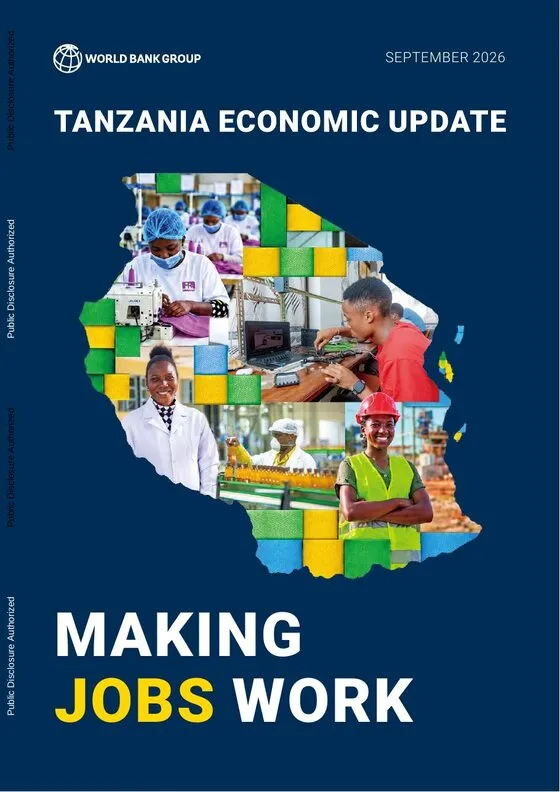
Cover of the World Bank Tanzania Economic Update, September 2026: Making Jobs Work
68.7%Employment-to-population ratio: more than two in three working-age Tanzanians had a job2024 · World Bank, Tanzania Economic Update, Sept 2026, p. 26
54%of the workforce is employed in agriculture2024 · World Bank, Tanzania Economic Update, Sept 2026, p. 26
TZS 1,005Median hourly pay, including profits and in-kind income (about US$0.40)2024 · World Bank, Tanzania Economic Update, Sept 2026, p. 26

Tanzania’s economic picture

Strong growth, steady prices, rising external pressure.

Growth reached 5.9% in 2025, helped by government spending around the October elections. Inflation stayed inside the target band. Higher fuel and freight costs widened the current account deficit.

Growth is set to rise to 6.5%

Real GDP growth, calendar years. 2026–2028 are World Bank baseline projections. Tap a point for its value.

Unit % annual changePeriod 2023–2028Source World Bank, Tanzania Economic Update, Sept 2026, Table 1.1, p. 24

6.0%growth in the first quarter of 2026Q1 2026 · World Bank, Tanzania Economic Update, Sept 2026, p. 4. Measured on the rebased national accounts (base year 2019), which break the series, so it is not shown on the annual line.
Over ⅔of 2025 growth came from government spending, against an average of 45% in 2021–20242025 · World Bank, Tanzania Economic Update, Sept 2026, p. 4
5.7%average annual growth over two decades, driven more by adding resources than by productivityWorld Bank, Tanzania Economic Update, Sept 2026, p. 27
What does this mean?

Tanzania’s growth is high by regional standards and is expected to rise further as private investment picks up. But 2025’s boost came largely from public spending ahead of the elections, which the World Bank expects to unwind. Poverty has barely moved: the share of people below the $4.20-a-day line is estimated at 69.8%, against 70% in 2018 (World Bank, Tanzania Economic Update, Sept 2026, p. 8).

Industry and services led growth in 2025

Real growth by sector in 2025, as described in the report’s text. Almost half of real growth came from services.

Unit % real growthPeriod 2025Source World Bank, Tanzania Economic Update, Sept 2026, p. 4

The report’s Table 1.1 (p. 24) gives different 2025 sector rates: agriculture 3.6%, industry 7.8%, services 5.8%. The report does not explain the difference. We show the figures from the text and list the table’s figures here so neither is hidden.

The baseline table, sector by sector

The World Bank’s model baseline from Table 1.1. 2026–2028 are projections.

Unit % annual changePeriod 2023–2028Source World Bank, Tanzania Economic Update, Sept 2026, Table 1.1, p. 24

What does this mean?

High food and mineral prices raised mining’s and agriculture’s share of output in money terms, but their real output was held back. Mature gold mines cannot easily produce more, and new projects only start in or after 2027. Fertiliser subsidies mainly reach richer farmers (World Bank, Tanzania Economic Update, Sept 2026, p. 4).

Inflation has stayed inside the 3–5% target band

Annual average consumer price inflation. The shaded band is the Bank of Tanzania’s medium-term target. 2026–2028 are projections.

Unit % annual averagePeriod 2023–2028Source World Bank, Tanzania Economic Update, Sept 2026, Table 1.1, p. 24; target band p. 10

4.2%headline inflation, year-on-year, with core inflation at 3.9%July 2026 · monthly reading, not comparable with the annual averages in the chart · World Bank, Tanzania Economic Update, Sept 2026, p. 10
6.25%Central Bank Rate after a 50 basis point rise in July 2026, to contain second-round effects of higher energy, fertiliser and transport costsWorld Bank, Tanzania Economic Update, Sept 2026, p. 10
28.1%private sector credit growth, a multi-year high, with bad loans at 2.5%, below the 5% thresholdJune 2026 · World Bank, Tanzania Economic Update, Sept 2026, p. 12
What does this mean?

The Bank of Tanzania now steers interest rates rather than money supply. That framework has kept inflation in the target band even as diesel pump prices rose about 60% between the start of the war in the Middle East and June 2026 (World Bank, Tanzania Economic Update, Sept 2026, p. 10).

Taxes beat the budget; non-tax revenue fell short

Collections and spending against the budget in the first eleven months of FY26. Tap a bar for detail.

Unit % above (+) or below (−) targetPeriod First 11 months of FY26Source World Bank, Tanzania Economic Update, Sept 2026, p. 14, 15

Public debt: 49% of GDP

End-June 2026 public debt stood at 49% of GDP. The line shows the baseline table, which uses calendar years and projects a gradual decline.

Unit % of GDPPeriod 2023–2028 (calendar years)Source World Bank, Tanzania Economic Update, Sept 2026, p. 15; World Bank, Tanzania Economic Update, Sept 2026, Table 1.1, p. 24

49% is a fiscal-year figure (end-June 2026). The table’s 48.5% is calendar 2025. The two are for different periods and are not directly comparable.

What does this mean?

The risk of debt distress remains moderate (World Bank, Tanzania Economic Update, Sept 2026, p. 17). But borrowing has become less concessional, with non-concessional external loans now close to one-fifth of public debt, which raises refinancing and interest rate risks (World Bank, Tanzania Economic Update, Sept 2026, p. 15).

Exports grew fast, imports grew faster

Year-on-year growth in FY26 (year ending June 2026). Goods exports are an estimate. Tap a bar for the dollar values.

Unit % changePeriod FY26 (year ending June 2026)Source World Bank, Tanzania Economic Update, Sept 2026, p. 18

The current account deficit widened

Deficit as a share of GDP. The two figures cover different periods: calendar 2025 and the fiscal year ending June 2026.

Unit % of GDPPeriod 2025 and FY26Source World Bank, Tanzania Economic Update, Sept 2026, p. 18

What does this mean?

Higher prices for oil, fertiliser and shipping linked to the war in the Middle East outweighed strong exports and high gold prices. Aid is also shrinking: official development assistance has halved as a share of GDP since 2010, and less of it now comes as grants (World Bank, Tanzania Economic Update, Sept 2026, p. 18, 19).

The jobs challenge

Tanzania does not face a jobs shortage. It faces a jobs quality challenge.

Having a job and having a good job are not the same thing. Scroll through what 100 squares can show.

  1. About 69 in 100

    working-age Tanzanians have a job. The employment-to-population ratio is 68.7%, among the highest in the world, up from 65.8% in 2020.

    World Bank, Tanzania Economic Update, Sept 2026, p. 26 · Squares are rounded to whole numbers.
  2. 75 · 17 · 8

    Of every 100 workers, 75 work for themselves, 17 help in a family business and only 8 are employees with an employer.

    World Bank, Tanzania Economic Update, Sept 2026, p. 26
  3. 54 in 100

    workers are in agriculture. Its share has fallen 6 percentage points since 2020, but it is still the biggest employer by far.

    World Bank, Tanzania Economic Update, Sept 2026, p. 26
  4. About 95 in 100

    jobs are informal, up from about 93 in 2020. The working-age population is growing faster than the formal job base.

    World Bank, Tanzania Economic Update, Sept 2026, p. 26 · Squares are rounded to whole numbers.
  5. About 2 in 100

    jobs are high-quality: decent pay, a written contract, social security and job security. That is about 550,000 out of 26 million jobs, and only about 120,000 of them are in the private sector.

    World Bank, Tanzania Economic Update, Sept 2026, p. 29 · Squares are rounded to whole numbers.

What makes a job “high-quality”?

The report uses four tests. A job must meet all four (World Bank, Tanzania Economic Update, Sept 2026, p. 28).

  • Decent payMore than TZS 3,830 an hour, about US$1.50: enough to lift an average household above the US$4.20-a-day poverty line on one income.
  • A written contractMinimum legal protection.
  • Social securityMembership of a contributory scheme such as NSSF or PSSSF.
  • Job securityConfidence of still having the job next month.

The pay gap to a quality job

Median hourly pay against the report’s high-pay benchmark and its decent-pay threshold. Tap a bar.

Unit TZS per hourPeriod 2024Source World Bank, Tanzania Economic Update, Sept 2026, p. 26, 28

Women and young people are left behind

Share of the working-age population, of all workers, and of high-quality jobs.

Women

Youth (15–35)

Unit % sharePeriod 2024Source World Bank, Tanzania Economic Update, Sept 2026, p. 29

Readiness

4.5 years

of real learning for the average adult once school quality is counted, below SSA and lower-middle-income peers. Only about 40% of secondary-age children are enrolled.

World Bank, Tanzania Economic Update, Sept 2026, p. 32

Skills

83%

of advertised jobs need skills that the current pool of applicants often lacks, while most hiring happens through personal networks.

World Bank, Tanzania Economic Update, Sept 2026, p. 33, citing TICGL 2025

Women

14% vs 4%

of time spent on unpaid care work by women and men. Women-led microenterprises are 46% less productive, because of the sectors they work in and less access to capital, not skills.

World Bank, Tanzania Economic Update, Sept 2026, p. 33

Social assistance is less than half the regional level

Spending on all social assistance programmes. Without protection, shocks push households to pull children from school or sell productive assets.

Unit % of GDPPeriod Latest availableSource World Bank, Tanzania Economic Update, Sept 2026, p. 35

Five people reach working age for every one who leaves

Each year, about 2 million Tanzanians reach working age while about 400,000 leave it, half through retirement and half through early death.

Unit people per yearPeriod Each year (projection-based)Source World Bank, Tanzania Economic Update, Sept 2026, p. 26

The two sides of the jobs challenge

Workers are not ready. Firms are not growing. Each holds the other back.

The report looks at both sides of the labour market at once: the people looking for better jobs, and the firms that could offer them.

The report sorts the labour force by two things: how ready people are for formal work, and how much opportunity exists where they live. Choose a group to see who is in it and what would help. (World Bank, Tanzania Economic Update, Sept 2026, p. 32, 33, Figure 2.1)

Q1 · Low readiness · Low opportunity

Expand productive employment: Over half of the labour force

Who: Rural informal workers, NEET youth, agricultural smallholders, subsistence self-employed.

What would help: Graduation programmes, cash and productive assets, foundational skills, second-chance education, social protection reform.

World Bank, Tanzania Economic Update, Sept 2026, p. 32

Q2 · High readiness · Low opportunity

Unlock talent: 15% of the labour force

Who: Skilled workers in thin markets, urban self-employed, informal artisans with credential gaps, workers with outdated skills.

What would help: Enterprise support, transport subsidies for rural–urban mobility, reskilling, recognition of prior learning, market linkages, seed capital.

World Bank, Tanzania Economic Update, Sept 2026, p. 33

Q3 · Low readiness · High opportunity

Bridge the gaps: 18% of the labour force

Who: Formal job seekers, skilled urban youth, secondary school graduates, recent TVET and university graduates.

What would help: Employer-driven training, TVET, recognition of prior learning, wage subsidies, job matching, apprenticeships.

World Bank, Tanzania Economic Update, Sept 2026, p. 33

Q4 · High readiness · High opportunity

Connect to jobs: 15% of the labour force

Who: Skilled graduates with networks, formal workers near the threshold, about 4 million formally employed workers.

What would help: Job-matching platforms, skills certification, advanced and digital skills, career services, in-work mobility support.

World Bank, Tanzania Economic Update, Sept 2026, p. 33
  • Low readinessMost workers entered work young, with little schooling and few foundational skills.
  • Limited opportunityFormal jobs are scarce outside major towns, and information about vacancies travels through personal networks.
  • Social protection gapsPSSN III will reach only 13% of households below the poverty line, and transfers are too small to cover the cost of moving to a better job.
  • Gender barriersCare work, early marriage and limited mobility keep women in the lowest-productivity work. About one-third of girls marry before 18.
  • Programmes that miss peopleMost training requires people to stop working to attend, which shuts out those who can least afford it. Impact evidence outside PSSN is thin.

World Bank, Tanzania Economic Update, Sept 2026, p. 35, 38

Most of Tanzania’s 219,371 registered establishments are micro firms: only 12.2% employ five or more people. Formal firms with five or more workers are the ones best placed to create quality jobs, and they face these constraints. (World Bank, Tanzania Economic Update, Sept 2026, p. 27; Section 05 has the comparisons.)

  • Low productivitySales per worker are about 49% below the SSA average in services and 70% below in manufacturing.
  • Few new firmsOnly 12% of formal firms are young, against 38% in Rwanda and 26% in Ghana.
  • Falling investmentThe average firm invests 11% of what it did a decade ago.
  • FinanceOne in three firms is fully or partially credit constrained (SSA average 22%).
  • Land58% of large firms call land access a major or very severe constraint (SSA average 20%).
  • Technology4% of manufacturers license foreign technology and 34% of firms have a website, against 11% and 42% in SSA.
  • Innovation7% of firms spend on R&D (SSA 13%), and 14% introduced a new product recently (SSA 25%).

World Bank, Tanzania Economic Update, Sept 2026, p. 40, 41, 43, 44

A reinforcing loop between workers and firmsA better-prepared workforce makes firms more productive. More productive firms create more high-quality jobs, which draw workers into better work.WorkforcereadinessProductivefirmsmakes firms more productivecreates more high-quality jobs
“More productive firms create more high-quality jobs, and a better-prepared workforce makes firms more productive.”

Skills shape whether firms invest and expand in the first place. Workers with lower secondary education earn 22–30% more in formal private jobs than those with only primary schooling. Entrepreneurs with basic education are nearly twice as likely to hire paid workers.

Native Media illustration of a relationship the report describes (pp. 41, 46). It is a diagram, not a measured World Bank index.

Why businesses struggle to create quality jobs

Too few new firms, too little investment, and a long tail of laggards.

From the World Bank Enterprise Survey of formal firms with five or more employees (2013 and 2023). Choose a finding.

Tanzanian firms produce far less per worker

Sales per worker compared with the Sub-Saharan Africa average.

Unit % difference from SSA averagePeriod WBES, various yearsSource World Bank, Tanzania Economic Update, Sept 2026, p. 40

What it means

Firms that produce less per worker cannot pay higher wages and stay profitable. Raising productivity is the precondition for better-paid jobs.

Few young firms enter the market

Share of formal firms that began operating after 2018.

Unit % of formal firmsPeriod 2023Source World Bank, Tanzania Economic Update, Sept 2026, p. 41

Entry rules are strong on paper; exit rules are weak

World Bank B-Ready 2025 scores out of 100. Business entry is in the top 20% globally; business insolvency is in the bottom 20%.

Unit score out of 100Period 2025Source World Bank, Tanzania Economic Update, Sept 2026, p. 41, 42

What it means

New firms bring new ideas and jobs, but 32% of firms started without registering (25% in 2013), and registering a foreign firm costs 59% of income per person. Weak insolvency rules keep non-viable “zombie” firms alive and make it harder to save viable ones (World Bank, Tanzania Economic Update, Sept 2026, p. 41, 42).

Fewer firms invest, and they invest less

Share of firms buying fixed assets, and the average amount invested (in 2009 US dollars).

Unit % of firms; US$ (2009)Period 2013 vs 2023Source World Bank, Tanzania Economic Update, Sept 2026, p. 43

What it means

The average firm now invests just 11% of what it did a decade ago, behind nearly all peers. Less investment means less new equipment, less technology and fewer jobs. National accounts show rising investment overall, driven by construction and public projects (World Bank, Tanzania Economic Update, Sept 2026, p. 43).

One in three firms cannot get the credit it needs

Firms fully or partially credit constrained, and firms that finance investment through banks.

Unit % of firmsPeriod 2023Source World Bank, Tanzania Economic Update, Sept 2026, p. 44

What it means

Banks mostly lend short-term for trade and working capital. Long-term money for machines, buildings and new products is scarce and expensive, and capital markets are still small.

Land is a major barrier for large firms

Large firms that call access to land a major or very severe constraint.

Unit % of large firmsPeriod 2023Source World Bank, Tanzania Economic Update, Sept 2026, p. 44

What it means

Unclear title, hard-to-find land records and slow permits make firms unsure that what they build will be protected, so they hold back long-term investment.

Firms adopt and invent less than their peers

Share of firms reporting each activity: Tanzania against the average of Sub-Saharan economies (Table 2.2).

Unit % of firmsPeriod WBES, various yearsSource World Bank, Tanzania Economic Update, Sept 2026, p. 44

What it means

Firms are selling increasingly outdated products. Only 20% offer formal training, and the share of skilled manufacturing workers fell from 85% in 2013 to 78% (World Bank, Tanzania Economic Update, Sept 2026, p. 44).

The best firms are 32 times more productive than the worst

Productivity of the top 10% of firms divided by the bottom 10%. A wide gap signals that resources are stuck in low-productivity firms.

Unit timesPeriod 2023Source World Bank, Tanzania Economic Update, Sept 2026, p. 45

What it means

The most productive “frontier” firms pay about four times higher wages, but they hold only 18% of jobs. Most formal jobs are in the other firms, so helping them grow, invest and catch up is the key to more quality jobs (World Bank, Tanzania Economic Update, Sept 2026, p. 45).

The two policy pillars

Expand the quality job base. Build the workforce to fill it.

These are the World Bank’s recommendations. They are proposals, not policies already in place. The report says they align with Vision 2050 and can help prioritise MKUMBI II.

Pillar 1

Expand the quality job base

Make it easier for firms to start, grow, invest, reorganise or close.

1Encourage firm entry
  • Link the digital systems of BRELA, TRA, local governments and regulators to end duplicate reporting.
  • Review unnecessary restrictions and costs on foreign firm registration and investment.
  • Publish fee schedules every year with notice of changes, and fund regulators from the budget rather than fees.
  • Support micro-enterprises with tiered licensing, Kiswahili digital registration and business support.
2Strengthen the insolvency framework
  • Protect creditors’ rights and enable viable firms to reorganise.
  • Train judges in insolvency and regulate insolvency administrators.
  • Create simpler, faster procedures for small enterprises.
  • Add cross-border insolvency provisions.
3Unlock long-term finance
  • Enact and implement the secured transactions law so more assets, such as receivables, count as collateral.
  • Bring utility and mobile money payment data into credit reporting. Mobile money reaches over 94% of Tanzanians.
  • Build on capital market reforms: lower listing barriers, blended finance, leasing and factoring.
4Give firms access to investable land
  • Keep improving the e-Ardhi digital land records so firms can check ownership and encumbrances.
  • Hold land officers accountable with performance indicators, tracking and automatic escalation of delayed requests.

Pillar 2

Build the quality workforce pipeline

Help workers become ready for better jobs and find them.

5Redesign social protection as a mobility enabler
  • Add income replacement within PSSN III for people in training, and pilot keeping transfers for those who enter wage jobs.
  • Make benefits portable across jobs and places.
6Prioritise the least-ready workers (Q1)
  • Move training into communities, in modular and part-time formats, instead of programmes people must leave work to attend.
  • Offer graduation-style packages: income support, foundational skills, productive assets and coaching.
  • Encourage secondary school completion and second-chance routes, especially for girls.
7Make gender-responsive design the standard
  • Require childcare and flexible arrangements in every programme.
  • Treat the care economy as a source of jobs, not only a constraint.
  • Set participation targets for women across labour market programmes.
8Build a labour market information system with real reach
  • Digitise the Public Employment Service and reward placements; launch a mobile national jobs portal in Kiswahili.
  • Hold employer recruitment events in secondary towns.
  • Use the system to read real-time labour demand and shape training.
9Build an employer-trusted recognition of prior learning system
  • Open at least three regional NACTVET assessment hubs outside Dar es Salaam.
  • Issue credentials as portable digital certificates.
  • Co-design credentials with employer associations from the start.

Condensed from the report’s recommendations, pp. 47–49. Open each item for detail.

The economic outlook

Faster growth ahead, with risks tilted to the downside.

The World Bank expects private investment, exports and industry to drive growth as the election spending fades. All figures below are projections.

6.1%GDP growth2026 projection · World Bank, Tanzania Economic Update, Sept 2026, p. 23
6.5%GDP growthMedium-term projection · World Bank, Tanzania Economic Update, Sept 2026, p. 23
3.1%Fiscal deficit, % of GDP2026 projection · World Bank, Tanzania Economic Update, Sept 2026, p. 23
4.1%Inflation2026 projection · World Bank, Tanzania Economic Update, Sept 2026, p. 23
6.8%Real export growth2026 projection · World Bank, Tanzania Economic Update, Sept 2026, p. 23
7.8%Industry growth2026 projection · World Bank, Tanzania Economic Update, Sept 2026, p. 23

Revenue is projected to keep rising

Government revenue as a share of GDP. The fiscal framework also assumes the tax-to-GDP ratio rises from 13% to 16% over the medium term.

Unit % of GDPPeriod 2023–2028Source World Bank, Tanzania Economic Update, Sept 2026, Table 1.1, p. 24; World Bank, Tanzania Economic Update, Sept 2026, p. 23

The most consequential choice

“Over the medium term, the most consequential policy choice is the sustained prioritization of human capital spending.”

The World Bank names human capital as the public spending most likely to sustain growth, create jobs and reduce poverty (World Bank, Tanzania Economic Update, Sept 2026, p. 24).

Explore the risks

The war in the Middle East

Middle East transit hubs are the usual connecting routes for tourists from Europe and Asia, and Gulf ports supply and transship goods for Tanzania. Prolonged disruption could hit tourism and transport exports and widen the current account deficit, possibly towards levels last seen in 2022. Gold exports give a partial hedge.

World Bank, Tanzania Economic Update, Sept 2026, p. 23, 24

Exports exposed to travel and shipping disruption

Share of Tanzania’s exports from tourism and from transport services.

Unit % of exportsPeriod CurrentSource World Bank, Tanzania Economic Update, Sept 2026, p. 23

Spending pressure and arrears

Election-related spending and a larger payroll showed that the risk of arrears and weak cash management is real. The report names revenue efficiency and cash management as priorities.

World Bank, Tanzania Economic Update, Sept 2026, p. 23, 24

The fiscal deficit is projected to narrow

Fiscal balance as a share of GDP; negative values are deficits.

Unit % of GDPPeriod 2023–2028Source World Bank, Tanzania Economic Update, Sept 2026, Table 1.1, p. 24

Keeping reforms on track

A loss of reform momentum, from political pressure or implementation limits, would weigh on private sector confidence and could undermine the growth path. The outlook relies on reforms under MKUMBI II, the second blueprint for investment climate reform.

World Bank, Tanzania Economic Update, Sept 2026, p. 23, 24
14%of senior managers’ time goes on regulatory compliance, up from 2% in 2013 and above the regional 8%World Bank, Tanzania Economic Update, Sept 2026, p. 42
~2%of GDP: foreign direct investment, flat since 2016World Bank, Tanzania Economic Update, Sept 2026, p. 41

Drought, floods and heat

Climate shocks remain a downside risk, especially for farm output and the most exposed households. Drought is the largest climate risk to Tanzanians, followed by floods and heatwaves.

World Bank, Tanzania Economic Update, Sept 2026, p. 9

People exposed and vulnerable to climate hazards

New World Bank research cited in the report (Brunckhorst et al. 2025). Places that are both exposed and least able to cope cluster in a diagonal belt through the centre of the country.

Unit peoplePeriod 2025 researchSource World Bank, Tanzania Economic Update, Sept 2026, p. 9

Key takeaways

Growth is not the problem. Turning it into good jobs is.

What the World Bank finds

  1. The economy grew 5.9% in 2025 and is projected to grow 6.1% in 2026 and 6.5% over the medium term.
  2. Almost everyone works, but about 95% of jobs are informal and only about 550,000 of 26 million jobs are high-quality.
  3. Workers lack readiness and opportunity: over half are in the low-readiness, low-opportunity group.
  4. Firms lack productivity and dynamism: few new firms, falling investment, scarce long-term finance and land.
  5. Two pillars respond: expand the quality job base, and build the quality workforce pipeline.

World Bank, Tanzania Economic Update, Sept 2026, p. 1, 2; pp. 23–49

Native Media perspective

Our reading of what the report means for different readers. This is editorial interpretation, not World Bank analysis. Every fact it rests on is from the report.

Policymakers

The report’s headline is that the jobs count is the wrong scoreboard. Counting high-quality jobs, about 550,000 today, would track what matters. Several of the firm-side fixes, such as joined-up registration systems, insolvency rules and land records, cost relatively little public money. And the report calls sustained human capital spending the most consequential choice.

Investors and businesses

The constraints are the ones firms already feel: credit (one firm in three), land (58% of large firms) and compliance time (14% of senior managers’ time). The reforms worth watching are the secured transactions law, credit data from mobile money and utilities, e-Ardhi land records and capital market changes. The report also calls labour-intensive exports such as manufactured and horticultural goods an underused opportunity.

Young people and workers

About 2 million people reach working age each year, so competition for good jobs will grow. The report’s evidence favours finishing secondary school: lower secondary earns 22–30% more in formal private jobs. TVET adds up to 51% for those with formal contracts. Proposed recognition of prior learning would let skilled informal workers prove what they can do.

Development partners

Programmes are small, fragmented and skewed towards urban, better-prepared workers. Most require people to stop working to attend, and outside PSSN there is little impact evidence. With aid halved as a share of GDP since 2010 and fewer grants, in our view that argues for programmes that are better coordinated, properly evaluated and designed to reach rural and informal workers.

World Bank, Tanzania Economic Update, Sept 2026, p. 29, 40, 42, 41, 38, 18, 19

The original report

Tanzania Economic Update, September 2026

Special Theme: Making Jobs Work · World Bank · Published September 2026, using information current as of August 2026.

Cite as

World Bank. 2026. Tanzania Economic Update, September 2026. Special Theme: Making Jobs Work. © World Bank.

Copyright and permissions. © 2026 The World Bank. Some rights reserved. “The material in this work is subject to copyright. Because The World Bank encourages dissemination of its knowledge, this work may be reproduced, in whole or in part, for noncommercial purposes as long as full attribution to this work is given.” (p. b). Queries on rights should go to World Bank Publications.

About this edition. Native Media built this interactive edition to make the report easier to explore. It is not a World Bank product. The World Bank report is the authoritative source. Figures are taken from it with page references and checked against the PDF. Text marked “Native Media perspective” is our own interpretation.

More reports we feature